
Group leader: Mamoru Hyodo Ph.D (Assistant Professor)
Gene
therapy is a technique for correcting defective genes responsible for disease
development. Gene therapy can be broadly
defined as the transfer of defined genetic material to specific target cells of
a patient for the ultimate purpose of preventing or altering a particular
disease state. Genes and DNA are now being introduced with the use of vectors
and various techniques to get high efficiency.
Sometimes,
the uptake of drugs with normal cells causes the undesired side effect. To
overcome these obstacles, it is necessary to equip the delivery system with
various functional devices such as ligands for specific receptors.
Aptamers
are artificial nucleic acid molecules that bind to molecular targets, including
proteins, with high affinity and specificity. Aptamers are typically from 20 to
50 nucleotides in length and can be composed of DNA, RNA, or peptide nucleic
acid (PNA) with a chemically modified sugar backbone (i.e., 2′-fluoro,
2′-O-methyl, phosphorothioate). The secondary structure of aptamers consists
primarily of short helical arms and single-stranded loops which are the
effective part to bind the target via vander Waals, hydrogen bonding, and
electrostatic interactions.
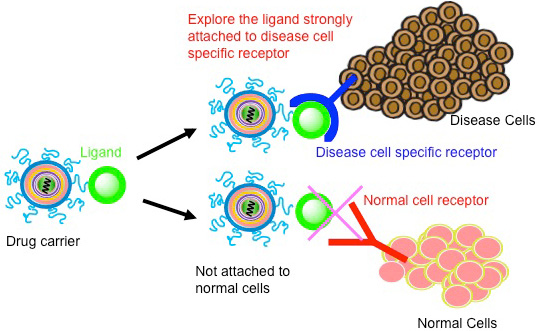
Our objection is to explore a new
artificial ligand (Aptamer) binding to disease cells by a method of cell based
SELEX (Systemic evolution of ligands by exponential enrichment), synthesize the
aptamer ligand with some chemical modification, and send drugs coated with MEND
attached our aptamer ligand.
If
you are interested in this project, Let’s make a contact with us.
